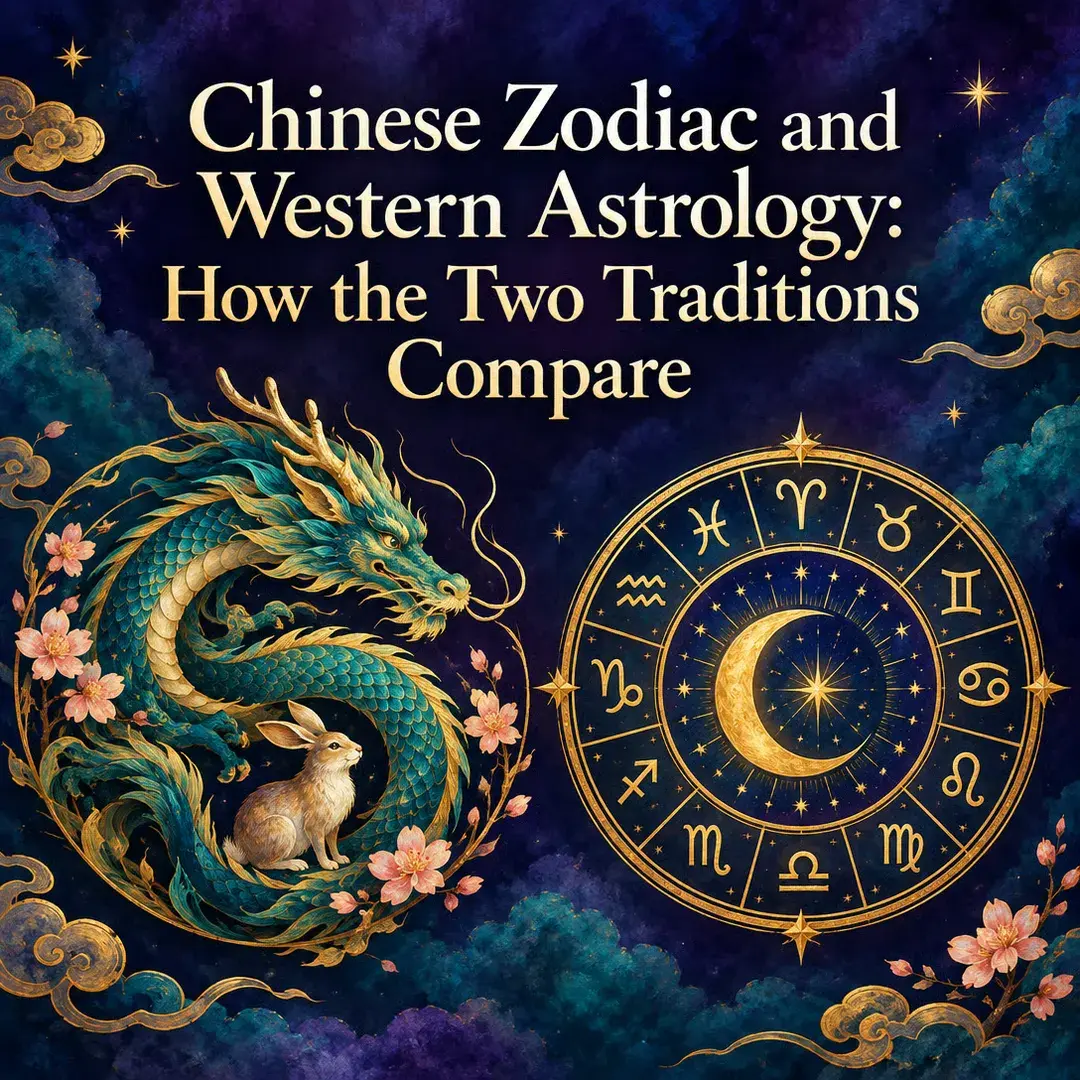
Chinese Zodiac and Western Astrology: How the Two Traditions Compare
Quick answer: The Chinese zodiac and Western astrology are two separate traditions that measure different things. The Chinese zodiac follows a lunisolar calendar and gives each year an animal and one of five elements, in a 60 year cycle. Western astrology follows the sun through twelve signs over a single year, so your sun sign depends on your birth month. Your year animal is not a version of your sun sign. Many people use both as two lenses on the same life.
Maybe you know you're a Leo, and someone just told you you're also a Horse. Or you grew up with Lunar New Year and now keep hearing about Mercury retrograde. Either way, it's natural to wonder how these fit together.
Here's the honest answer: they don't need to fit together, because each one is complete on its own. Chinese astrology grew out of Chinese calendar science and philosophy. Western astrology grew out of Babylonian and Greek sky watching. Let's look at them side by side, as equals.
Where Each Tradition Comes From
The Chinese zodiac
The twelve animals are called the Shēngxiào (生肖). They belong to a much larger calendar system, Tiāngān Dìzhī (天干地支), the Heavenly Stems and Earthly Branches. The stems and branches are attested on Shang dynasty oracle bones more than 3,000 years ago, where they were used to count days.
Animals linked to the twelve branches show up in Qin dynasty bamboo texts excavated at Shuìhǔdì (睡虎地), dating to the 3rd century BCE, though those early lists differ from today's in places. By the Eastern Han, the philosopher Wang Chong's Lùnhéng (论衡), written in the 1st century CE, is the earliest surviving text to name the same twelve animals we use today: Rat 鼠 shǔ, Ox 牛 niú, Tiger 虎 hǔ, Rabbit 兔 tù, Dragon 龙 lóng, Snake 蛇 shé, Horse 马 mǎ, Goat 羊 yáng, Monkey 猴 hóu, Rooster 鸡 jī, Dog 狗 gǒu and Pig 猪 zhū.
You may know the story of how the order was set. According to legend, the Jade Emperor (玉皇大帝 Yùhuáng Dàdì) held a Great Race, and the animals took their places in the order they arrived. Versions of the tale differ, and it's a folk story told long after the system took shape.
Western astrology
Western astrology traces back through the Hellenistic world to Babylonian astronomers, who watched the sun, moon and planets move against the stars. The system most Western astrologers still build on was set down in Ptolemy's Tetrabiblos in the 2nd century CE. Its twelve signs, Aries through Pisces, are named for constellations along the sun's yearly path.
Two Different Calendars
This is the biggest difference, and the one that clears up most confusion.
The Chinese calendar is lunisolar. Its months follow the moon, and the year is kept in step with the sun. The new year, Chūnjié (春节), the Spring Festival or Lunar New Year, lands on a new moon in late January or February. That's when the animal changes. The 2026 Fire Horse year, for example, runs from February 17, 2026 to February 5, 2027. Practitioners of Bāzì (八字), the "eight characters" birth chart, use Lìchūn (立春), the solar start of spring around February 4, as their boundary instead.
Western astrology uses the tropical zodiac. It's tied to the seasons, with Aries beginning at the March equinox. The sun moves through all twelve signs every year, spending about a month in each. That's why your sun sign depends on your birth month, and why we talk about zodiac seasons like Leo season or Scorpio season.
So the twelve animals mark a cycle of years, and the twelve Western signs mark a cycle of months. Everyone born in the same Chinese year shares an animal. Everyone born in the same few weeks of any year shares a sun sign. (In Bāzì, the same twelve Earthly Branches also mark the months, days and hours, so the Chinese system has its own deeper layers of time too.)
What Each One Measures
Your Chinese year animal comes from the Earthly Branch of your birth year. The year also carries one of five elements from its Heavenly Stem, plus yin or yang, which together make the 60 year cycle. In a full Bāzì reading, your birth month, day and hour each add their own stem and branch, eight characters in all.
Your Western sun sign is where the sun was in the zodiac when you were born. A full natal chart adds the moon, the rising sign, the planets and the houses.
Notice the pattern? Both traditions go far deeper than the one sign most people know. The headline sign is the front door, not the whole house.
Why the Animals Aren't Sun Sign Equivalents
You'll sometimes see charts matching the Rat to Aries or the Ox to Taurus. They don't line up. The animals and the Western signs come from different calendars, count different units of time and describe different things. Matching them flattens both traditions. A Rat isn't "Chinese Aries," and Aries isn't "Western Rat." Each sign means what it means inside its own system.
Elements in Each Tradition
Both traditions talk about elements, and both include Fire. That makes it easy to assume they're the same idea. They're not.
Chinese astrology uses Wǔxíng (五行), the five phases: Wood (木), Fire (火), Earth (土), Metal (金) and Water (水). They describe stages of change and work through a generating cycle (相生 xiāngshēng) and a controlling cycle (相克 xiāngkè). The year's element rotates with the Heavenly Stems, and each animal also has a fixed element of its own. Our guide to Chinese zodiac elements walks through all five.
Western astrology uses four elements: Fire, Earth, Air and Water. The idea comes from Greek philosophy, where Empedocles described them around 450 BCE. In astrology they group the twelve signs into sets of three. Each sign's element is permanent, so Leo is always Fire.
Different count, different roots, different job. Wood and Metal have no place in the Western set, and Air has no place in Wǔxíng. When a Horse is called a Fire animal and Leo is called a Fire sign, the same English word is doing two different jobs.
Side by Side at a Glance
| Chinese zodiac | Western astrology | |
|---|---|---|
| Main sign | Year animal (Shēngxiào 生肖) | Sun sign |
| Calendar | Lunisolar, year begins at Lunar New Year | Tropical zodiac, tied to the March equinox |
| Cycle | 12 animals over 12 years, 60 year stem and branch cycle | 12 signs over one year |
| Elements | Five phases (Wǔxíng), rotating by year plus a fixed element per animal | Four elements, fixed per sign |
| Other key ideas | Yin and yang, Heavenly Stems, Earthly Branches | Modalities, planets, houses, aspects |
| Full chart | Bāzì: year, month, day and hour pillars | Natal chart: sun, moon, rising, planets |
| Early written roots | Shang oracle bones, Qin and Han texts | Babylonian records, Hellenistic texts, Ptolemy |
How People Use Both Together
Many people follow both traditions, and they get the most from them by keeping them separate. Think of your year animal and your sun sign as two lenses. Each shows you something real, and neither replaces the other.
Take someone born on August 1, 1966. In the Chinese calendar, that date falls in the Fire Horse year (丙午), which ran from January 21, 1966 to February 8, 1967. In Western astrology, it falls in Leo season. So she's a Fire Horse with a Leo sun.
Through the Chinese lens, the Horse traditionally suggests energy, independence, warmth with people and a strong need to keep moving, and a Fire year turns that up. Read more on our Year of the Horse page. Through the Western lens, Leos are known for generosity, loyalty, creative spark and a wish to be truly seen. Where the two lenses echo each other, like a love of being active and around people, she might lean on that. Where they differ, she gets a fuller picture than either one alone. Both are tendencies, never fixed fate.
And babies born in Leo season this past summer are Fire Horses too, since the 2026 Fire Horse year covered all of it.
A note for men: having two frameworks is simply good social intelligence. One reads timing across years, the other across months. Used together, they give you more ways to understand the people in your life and solve problems with them.
Both traditions also have their own compatibility systems. Our zodiac compatibility guide covers the Western signs, and Chinese zodiac compatibility guides are coming soon. Meanwhile, you can meet all twelve animals in our Chinese zodiac signs guide, or see what the coming year may bring for every animal in our Chinese New Year 2027 forecast.
If you'd like to look at both lenses on your own life at once, a reading can explore your chart and your situation together, with someone experienced who sits outside it.
Want to See Your Year Animal and Sun Sign Together?
The Psychic Line is an independent psychic service you can trust, since 1991. Call us at (800) 966 2294 to connect with a reader, or book an astrology reading or spiritual reading whenever you feel ready. New client readings start at $30 for a full 15 minutes.
Respecting Both Traditions
Chinese astrology isn't a novelty version of horoscopes. It's part of a living calendar that millions of people use to mark the new year, honor elders and plan important days. Western astrology has its own long history and devoted students. Each deserves to be learned in its own terms, with its own words. That's why we keep the Chinese names, like Shēngxiào and Wǔxíng, alongside the English. For more on the stars and cycles, browse our astrology articles.
Frequently Asked Questions
Is the Chinese zodiac the same as Western astrology?
No. They're separate traditions with different origins and calendars. The Chinese zodiac assigns an animal and element to each lunisolar year in a 60 year cycle. Western astrology follows the sun through twelve signs each year, so your sun sign depends on your birth month. Each is complete on its own, and neither is a version of the other.
Which Western sign matches my Chinese zodiac animal?
None of them, really. The animals mark years and the Western signs mark months, so they measure different things. Charts that pair the Rat with Aries or the Ox with Taurus flatten both systems. It's more useful to read your year animal and your sun sign as two separate lenses that each show you something.
Are the Chinese and Western elements the same?
No. Chinese astrology uses Wǔxíng, five phases of change: Wood, Fire, Earth, Metal and Water, which rotate by year and interact through generating and controlling cycles. Western astrology uses four elements, Fire, Earth, Air and Water, fixed to each sign. Both include Fire, but the word means something different in each system.
Can I follow both Chinese and Western astrology?
Yes, and many people do. The easiest way is to keep them separate. Learn your year animal and element from the Chinese calendar, learn your sun sign from your birth date, and notice where they echo each other and where they differ. Together they give you a fuller picture than either one alone.
Why is my Chinese zodiac sign different from what I expected?
If you were born in January or February, check the Lunar New Year date for your birth year. The Chinese year starts at Lunar New Year, not January 1, so early birthdays often belong to the year before. Bāzì practitioners use Lìchūn, around February 4, as the boundary instead.
What is a Fire Horse born in Leo season?
It's someone born in a Fire Horse year, like 1966 or 2026, during the weeks when the sun is in Leo, roughly late July to late August. Her Chinese year animal is the Horse, her year element is Fire, and her Western sun sign is Leo. Each describes her through a different tradition.
Ready to Talk with a Gifted Reader?
The Psychic Line is an independent psychic service you can trust, since 1991. Call us at (800) 966 2294 to connect with a reader, or book a spiritual reading or relationship reading whenever you feel ready. New client readings start at $30 for a full 15 minutes.
Want to choose your own reader? Browse our psychic readers, or read why we've stayed completely independent since 1991.
- Log in to post comments