
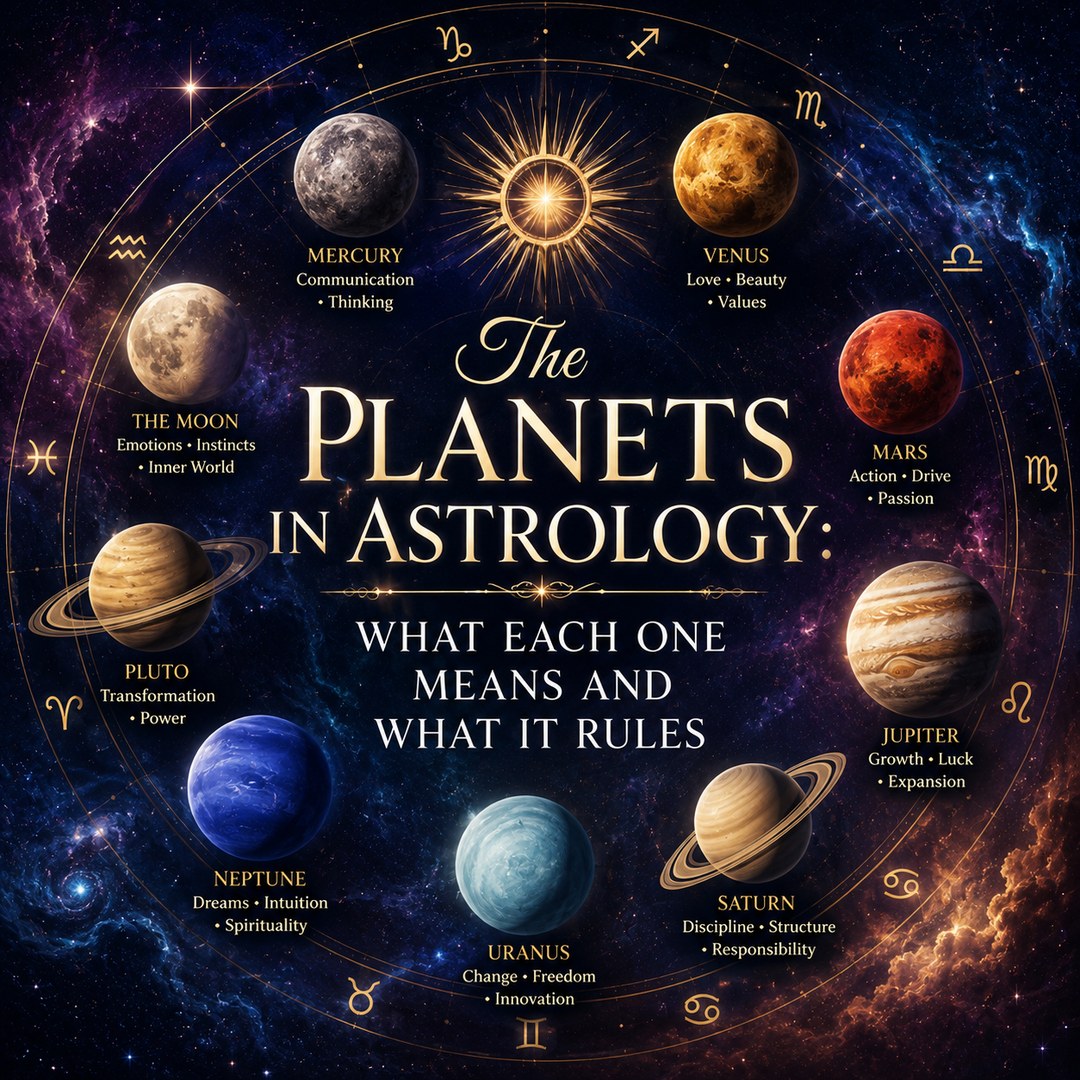
The Planets in Astrology: What Each One Means and What It Rules
Quick answer: Astrology uses ten planets, counting the Sun and Moon, and each one governs a category of experience. The Sun is identity, the Moon is emotion, Mercury is thinking, Venus is love and value, Mars is drive. Jupiter and Saturn handle growth and limits. Uranus, Neptune, and Pluto move so slowly that they describe whole generations rather than individuals.
If signs are the adjectives in astrology, planets are the nouns. The sign describes a style. The planet is the thing being styled.
That is why "I am a Scorpio" tells you less than people think. Scorpio is a flavor. The question is what is in Scorpio. Venus in Scorpio and Mars in Scorpio produce very different people.
This page covers all ten: what each governs, how fast it moves, and why some matter enormously in your chart while others barely register as personal at all. For the wider framework, start with what astrology is.
Why Astrologers Call the Sun and Moon Planets
Strictly, the Sun is a star and the Moon is a satellite. Astrology calls all ten of them planets anyway, and the word is older than the objection. Planet comes from the Greek for wanderer, and it originally meant any light that moved against the fixed background of stars. The Sun and Moon wander, so they counted.
Astrologers sometimes say luminaries instead when they mean the Sun and Moon specifically. Both terms are correct and you will see both.
How Fast Each Planet Moves
Speed is the single most useful thing to know about a planet, because it tells you whether a placement is about you or about everyone born around the same time as you.
| Planet | Time in one sign | Full cycle |
|---|---|---|
| Moon | About 2 and a half days | About 28 days |
| Mercury | About 3 to 4 weeks | About 1 year |
| Venus | About 4 to 5 weeks | About 1 year |
| Sun | About 1 month | 1 year |
| Mars | About 6 to 7 weeks | About 2 years |
| Jupiter | About 1 year | About 12 years |
| Saturn | About 2 and a half years | About 29 years |
| Uranus | About 7 years | About 84 years |
| Neptune | About 14 years | About 165 years |
| Pluto | 12 to 21 years | About 248 years |
Look at the top of that table and the bottom. The Moon changes sign before most people finish a work week. Neptune takes fourteen years. That gap is the whole reason astrologers sort planets into three groups.
The Three Groups
Personal planets are the Sun, Moon, Mercury, Venus, and Mars. They move quickly enough that yours are genuinely your own. These five do most of the work in describing a personality.
Social planets are Jupiter and Saturn. They move slowly enough to be shared with people born within a year or two of you, but fast enough to still say something specific. They deal with how you meet the wider world: opportunity, ambition, responsibility, limits.
Generational planets are Uranus, Neptune, and Pluto. Everyone born within roughly a decade of you shares your placement. On their own they describe a generation, not a person. They become personal when they touch something else in your chart closely, or when they transit it.
This is the fastest way to sort useful information from noise. If someone tells you your Neptune sign explains your personality, they have skipped the part where forty million other people have the same one.
The Ten Planets
The Sun
Identity, vitality, purpose. The Sun is what people mean by their sign. It describes your core self, what energizes you, and what you are here to develop. It spends about a month in each sign, and those stretches are the zodiac seasons. Rules Leo. More in the Sun in astrology.
The Moon
Emotion, instinct, need. The Moon is your inner life, how you feel things and what you need to feel safe. It is the private version of you, the one that shows up when nobody is watching, which is why two people with the same Sun sign can be so unalike. Rules Cancer. More in moon signs.
Mercury
Thinking, speaking, learning. Mercury governs how your mind works: how you process information, how you argue, how you write a text message. It is also the planet everyone knows for going backward three or four times a year, covered in Mercury retrograde. Rules Gemini and Virgo. More in Mercury signs.
Venus
Love, money, beauty, worth. Venus covers what you find attractive and what you consider valuable, which turn out to be the same question asked two ways. It shapes how you show affection and how you want to receive it. Venus turns retrograde only once every eighteen months, which is why Venus retrograde gets so much attention when it does. Rules Taurus and Libra. More in Venus signs.
Mars
Drive, desire, conflict. Mars is how you go after what you want and what you do when something gets in the way. Anger lives here, and so does courage. It is the planet of action rather than intention. Rules Aries, and traditionally Scorpio. More in Mars signs.
Jupiter
Growth, belief, opportunity. Jupiter expands whatever it touches, which is generous and occasionally excessive. It governs your sense of meaning, your appetite for risk, and where things tend to come easily. It spends about a year in each sign, so your Jupiter return arrives roughly every twelve years. Rules Sagittarius, and traditionally Pisces. More in Jupiter signs.
Saturn
Structure, limits, time. Saturn has the worst reputation and the best track record. It governs discipline, consequence, and the slow business of becoming competent at something. Saturn returns to its birth position around age twenty nine, and again near fifty eight, and most people can tell you exactly what was happening in their life at that age. Rules Capricorn, and traditionally Aquarius. More in Saturn signs and Saturn retrograde.
Uranus
Disruption, independence, sudden change. Uranus breaks things open, usually the things that had gone rigid. It spends about seven years in a sign, so as a birth placement it describes where your generation refuses to do things the old way. As a transit it is the source of the change nobody saw coming. Rules Aquarius in modern astrology. More in Uranus retrograde.
Neptune
Imagination, intuition, dissolution. Neptune softens edges. It governs dreams, art, compassion, spirituality, and also confusion and self deception, because those are the same capacity pointed different directions. Fourteen years per sign makes it firmly generational. Rules Pisces in modern astrology. More in Neptune retrograde.
Pluto
Power, depth, transformation. Pluto deals in what is buried and what eventually has to surface. It governs power dynamics, obsession, and the kind of change that does not let you go back to how you were. Astronomers reclassified it in 2006 and astrologers kept using it, because its symbolic track record did not depend on the label. Rules Scorpio in modern astrology. More in Pluto retrograde.
Want to Know What Your Own Placements Say?
The Psychic Line is an independent psychic service you can trust, since 1991. Call us at (800) 966 2294 to connect with a reader, or book an astrology reading or spiritual reading whenever you feel ready.
The three slowest planets each have a full guide of their own: Uranus in each sign, Neptune in each sign, and Pluto in each sign, with birth year tables so you can find yours without a chart. The North Node, the point that shows where your life is asking you to grow, has one too. And our birth chart calculator places every one of them for you, sign and house, from your birth details.
Which Planet Rules Which Sign
Every sign has a ruling planet, and that planet colors the sign the way a key colors a piece of music. Before the outer planets were discovered, seven planets covered all twelve signs, so five of them ruled two each. Modern astrology reassigned three of those. Both systems are still in use and most astrologers reference both.
| Sign | Traditional ruler | Modern ruler |
|---|---|---|
| Aries | Mars | Mars |
| Taurus | Venus | Venus |
| Gemini | Mercury | Mercury |
| Cancer | Moon | Moon |
| Leo | Sun | Sun |
| Virgo | Mercury | Mercury |
| Libra | Venus | Venus |
| Scorpio | Mars | Pluto |
| Sagittarius | Jupiter | Jupiter |
| Capricorn | Saturn | Saturn |
| Aquarius | Saturn | Uranus |
| Pisces | Jupiter | Neptune |
This is why a season carries the flavor of its ruler. Libra season leans Venusian and turns everything toward relationship and fairness. Capricorn season leans Saturnian and turns everything toward structure and consequence.
What About the Rising Sign?
The rising sign is not a planet, which trips a lot of people up. It is a point, specifically the degree of the zodiac that was coming over the eastern horizon at the moment you were born.
That makes it just as important as any placement, because it sets the structure of your entire chart and decides which planet lands in which area of your life. It is also the reason your birth time matters. The rising sign changes roughly every two hours.
Sun, Moon, and rising together are what astrologers call the big three, and they are where almost everyone starts. More on that one point in rising signs.
How Planets Show Up in Real Life
A planet appears in your experience two ways, and telling them apart saves a lot of confusion.
In your birth chart, a planet describes a permanent feature of how you are built. Your Mars sign does not change. It describes how you have pursued things your whole life and how you always will.
By transit, a planet describes a passing condition. Mars is currently moving through some sign right now, for everyone, and that says something about the collective mood rather than about you specifically. The zodiac seasons are the easiest transit to observe, because the Sun keeps a very predictable schedule.
Most of what makes astrology feel accurate is the interaction between the two. A transit lands hardest when it touches something already in your chart.
Common Questions About the Planets
How many planets are there in astrology?
Ten, counting the Sun and Moon: Sun, Moon, Mercury, Venus, Mars, Jupiter, Saturn, Uranus, Neptune, and Pluto. Astrology uses the older meaning of planet, which was any light that moved against the fixed stars.
What are the personal planets?
The Sun, Moon, Mercury, Venus, and Mars. They move quickly enough that your placements are genuinely individual, and they do most of the work in describing a personality.
Why do Uranus, Neptune, and Pluto matter less in a birth chart?
Because they move so slowly that everyone born within roughly seven to twenty years shares the same sign. On their own they describe a generation. They become personal when they closely touch a personal planet or angle in your chart.
Is Pluto still used in astrology?
Yes. Astronomers reclassified Pluto as a dwarf planet in 2006, but astrology is a symbolic system rather than an astronomical one, and Pluto's symbolic use did not depend on the classification. Astrologers still read it as the planet of power and transformation.
Which planet is the most important in a birth chart?
It depends what you are asking. The Sun describes identity, the Moon describes emotional life, and the rising sign organizes everything else. Those three together tell you more than any single placement.
What is a Saturn return?
Saturn takes about twenty nine years to complete one orbit, so around age twenty nine it returns to the exact spot it occupied when you were born. It is usually remembered as a period of restructuring, when things built on a weak foundation get tested. A second one arrives near fifty eight.
What does it mean when a planet is retrograde?
It means the planet appears to move backward from our point of view on Earth. Nothing physically reverses. Astrologically the planet's themes are read as turning inward for review rather than moving forward. Our retrograde dates page shows when those windows fall.
Browse more in our Astrology and Moon Energy section, or look up any term in our psychic terms glossary.
Ready to Talk with a Gifted Reader?
The Psychic Line is an independent psychic service you can trust, since 1991. Call us at (800) 966 2294 to connect with a reader, or book a clairvoyant reading or spiritual reading whenever you feel ready.
- Log in to post comments


