Native American Full Moons and Their Meanings: How Moon Energy Affects Your Emotions, Intuition, and Life Path
Quick answer: Every full moon of the year carries a traditional name, Wolf Moon in January, Flower Moon in May, Harvest Moon in September, and each name tells you what that season asked of the people who coined it. Many of these names come from Native American peoples, who read the moon as a natural calendar; others arrived with European folk traditions. Read together, the twelve moons form a yearly rhythm of emotion and energy, and knowing which moon you are standing under is often the first clue to why you feel the way you do.
Where the Full Moon Names Come From
Long before wall calendars, the moon kept time. Many Native American peoples, including the Algonquin nations of the Northeast, named each full moon for what was happening on the land beneath it: the wolves heard in the January cold, the worms surfacing in the March thaw, the corn ready under the September moon. Colonial settlers adopted many of these names, mixed in folk names of their own, and the Farmers' Almanac later made the blended list famous. That is the list most of us know today.
What makes these names worth more than trivia is what they encode. Each one captures a season's mood, scarcity and endurance in winter, awakening in spring, fullness in summer, gathering and letting go in fall, and those moods still move through us, central heating notwithstanding. At The Psychic Line, we hear it on the phones every month: calls rise around the full moon, from thoughtful people who feel something shifting and want to understand it. If that is you, the moon by moon guide below is a good place to start, and our posts on why energy feels different during a full moon and full moon restlessness go deeper into the why.
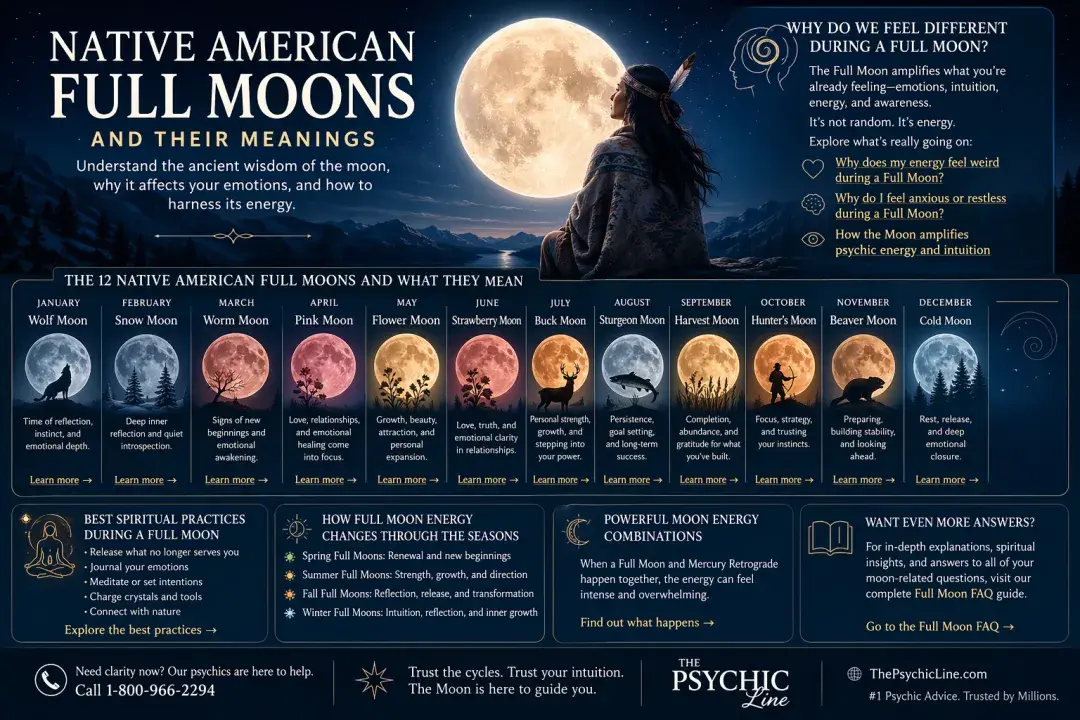
The 12 Full Moon Names and Their Meanings
January: the Wolf Moon. Named for the wolves heard howling in midwinter, when the nights are longest and the world goes quiet. This is the year's most reflective moon, and it tends to stir sensitivity, memory, and the deep questions that only surface in stillness. Our guide to the Wolf Moon's spiritual meaning explores why it lands so emotionally.
February: the Snow Moon. Named for the heaviest snows of the year, this moon carries winter's most inward energy: withdrawal, quiet, and the kind of inner work that needs a closed door. If you feel like hibernating in February, you are on schedule. Here is what the Snow Moon means and how to use its quiet well.
March: the Worm Moon. Named for the earthworms that surface as the ground thaws, the first stirring of the year. This moon marks awakening: energy returning, plans resurfacing, the itch to begin. Our Worm Moon guide covers the fresh start energy in full.
April: the Pink Moon. Named for creeping phlox, one of spring's earliest wildflowers, not for the moon's color. This is the year's moon of the heart: love, reconnection, and tending what winter strained. If relationships are on your mind in April, the Pink Moon is speaking your language.
May: the Flower Moon. Named for the full bloom of late spring, this moon carries growth, confidence, and attraction. People tend to feel more open and more social under it, and things planted earlier, projects and connections alike, start visibly flowering. Here is the Flower Moon's full meaning.
June: the Strawberry Moon. Named for the short, sweet strawberry harvest, this moon brings ripeness and truth. It favors honest conversations in love, savoring what is good, and recognizing that some sweetness has a season. Our Strawberry Moon guide goes deeper.
July: the Buck Moon. Named for the season when bucks grow new antlers, this is the moon of visible growth and personal strength. It tends to push: step into your power, claim the bigger role, wear the growth openly. Here is what the Buck Moon means for that push.
August: the Sturgeon Moon. Named for the giant fish most easily caught in late summer, this moon rewards patience and persistence, the long effort finally surfacing results. It is a strong moon for staying the course. Our Sturgeon Moon guide covers it.
September: the Harvest Moon. The famous one: the full moon nearest the autumn equinox, bright enough that harvesting once continued into the night. Also called the Corn Moon, it carries completion, abundance, and honest accounting of what the year has grown. Here is the Harvest Moon's full story.
October: the Hunter's Moon. Named for the hunting season that followed the harvest, this moon is about preparation and provision, gathering what the coming winter will need. Emotionally it often brings focus and a touch of urgency. Our Hunter's Moon guide explains the energy.
November: the Beaver Moon. Named for the beavers finishing their lodges before winter ice arrives, this moon carries industriousness and shelter: finishing what protects you, at home and within. Here is what the Beaver Moon means.
December: the Cold Moon. The longest nights of the year belong to this moon, and it closes the cycle with endurance, rest, and reflection on the whole year behind you. Our Cold Moon guide is the natural year's end read.
Beyond the Twelve: Blue Moons and Supermoons
Two more moons deserve a place on this map. A blue moon is the rare extra full moon, the second in a single month or the third of four in a season, and tradition reads it as a once in a while window for the wishes and decisions you keep postponing; our blue moon guide covers it. A supermoon is any full moon at its closest approach to Earth, visibly larger and brighter, and it turns up the volume on whatever its month's moon already carries; here is what a supermoon means when one is coming.
Feeling This Month's Moon and Wondering What It Is Telling You?
The Psychic Line is an independent psychic service you can trust, since 1991. Call us at (800) 966 2294 to connect with a reader, or book a spiritual reading or clairvoyant reading whenever you feel ready.
The Moons by Season
The twelve moons also read beautifully as four seasonal chapters, each with its own arc. Our seasonal guides walk through them: the winter moons of reflection and inner growth, the spring moons of renewal and love, the summer moons of strength and direction, and the fall moons of release and transformation. And because every full moon rises in a zodiac sign, the astrological season it falls in colors the energy too; our zodiac seasons guide maps that second layer.
How to Work with Full Moon Energy
Start by noticing rather than doing: for one full moon, simply track what you feel in the two or three days around it, mood, sleep, the thoughts that get louder. Most people find a personal pattern within a few cycles, and the pattern is the real teacher. From there, small practices go a long way, reflection, release writing, moonlight walks, intention setting matched to the month's meaning, and our full moon questions and answers page collects the best practices along with everything else people ask.
Full moons also tend to sharpen intuition, which is why so many people report vivid dreams and strong gut feelings around them; our post on how the moon amplifies psychic energy explains the tradition, and if your own sensitivity has been growing moon by moon, our guide to recognizing your intuitive side is the natural next read. One more for the curious: what happens when Mercury retrograde and a full moon overlap, the month's two most talked about energies at once.
Common Questions About Full Moon Names
What are the 12 full moon names in order?
Wolf Moon (January), Snow Moon (February), Worm Moon (March), Pink Moon (April), Flower Moon (May), Strawberry Moon (June), Buck Moon (July), Sturgeon Moon (August), Harvest or Corn Moon (September), Hunter's Moon (October), Beaver Moon (November), and Cold Moon (December).
Where do the full moon names come from?
Many come from Native American peoples, including the Algonquin nations, who used the moon as a natural calendar and named each one for the season's events. Colonial and European folk names joined the list over time, and the Farmers' Almanac popularized the blended version used today.
Why do I feel different during a full moon?
You are in good company; people have reported stronger emotions, lighter sleep, and sharper intuition around full moons for centuries. Tradition reads the full moon as the peak of a monthly energy cycle, a natural moment when whatever you have been carrying rises to the surface and asks for attention.
Is the Pink Moon actually pink?
No. It is named for creeping phlox, a pink wildflower that blooms in early spring when this moon rises. Most of the moon names describe the season on the ground, not the moon's appearance.
What is the best thing to do during a full moon?
Match the practice to the moon: reflection under the winter moons, beginnings under the spring ones, bold steps in summer, and release in fall. Simple rituals work best, honest journaling, a walk in the moonlight, one intention named clearly, and your own read on the moment counts most.
Ready to Talk with a Gifted Reader?
The Psychic Line is an independent psychic service you can trust, since 1991. Call us at (800) 966 2294 to connect with a reader, or book a clairvoyant reading or spiritual reading whenever you feel ready.
- Log in to post comments