
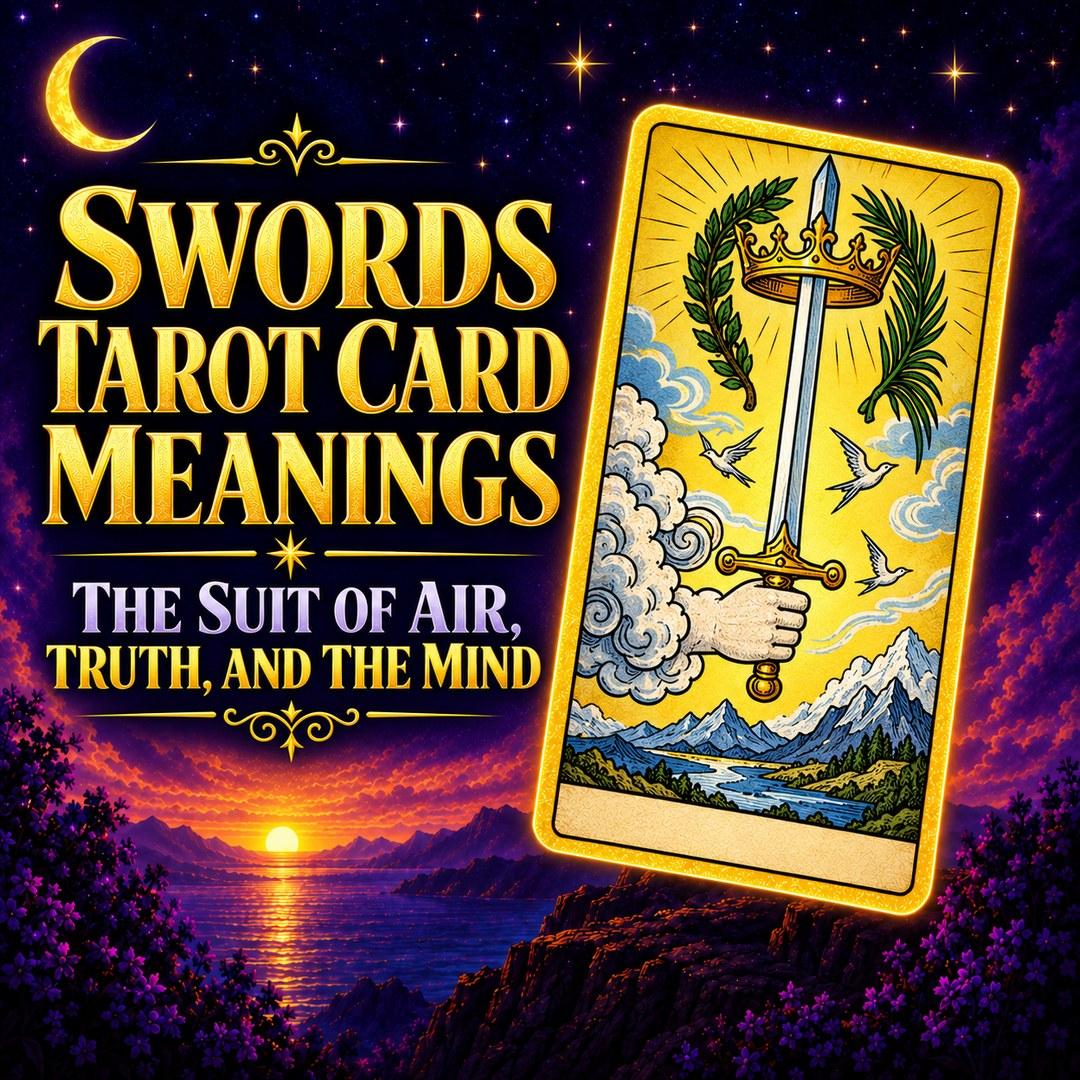
The suit of Swords is the most mentally intense suit in the tarot deck. These 14 cards deal with thought, truth, communication, conflict, decisions, and the sometimes uncomfortable experience of seeing things exactly as they are. When Swords cards dominate a reading, the situation is primarily intellectual or communicative in nature, and the most important information will come from honest, clear eyed thinking rather than from feelings or practical action.
Swords are associated with the element of Air. Air moves quickly and invisibly, carries words and thoughts from one place to another, and cuts through fog with clarity. A blade, which is the symbol of this suit, both wounds and restores depending on how it is used. Swords in tarot work the same way: they surface truth, and truth is not always comfortable. But without it, nothing real can be built.
If Swords cards are appearing in your readings and you want to understand what they are pointing to in your situation, our readers at The Psychic Line have been doing tarot readings since 1991. Call us at (800) 966 2294.
What the Suit of Swords Means in Tarot
Swords represent the mental dimension of life: thoughts, communication, decisions, conflict, truth, intellectual clarity, and the sometimes difficult process of facing what is actually real in a situation.
As part of the Minor Arcana, Swords sit alongside Cups (emotion and love), Wands (passion and action), and Pentacles (money and the material world). Each suit covers a different dimension of human experience. Swords covers the dimension of thought: what someone is thinking, what is being said or not said, what truths are present but unacknowledged, and what conflicts are forming or resolving.
Swords cards appear most often in readings about difficult conversations, major decisions, conflict in relationships or at work, anxiety and mental health, legal matters, and situations where something real needs to be seen and named before anything else can move forward. A reading full of Swords is telling you that the mental dimension of the situation is where the most important work needs to happen.
Swords in Conflict and Decision Readings
Swords are the suit most associated with conflict, difficult truths, and the kind of decisions that cannot be delayed much longer without real consequences.
This gives Swords a reputation for being a "difficult" suit, and it is true that some of the most challenging cards in the Minor Arcana live here: the Three of Swords, the Nine of Swords, the Ten of Swords. But Swords also bring the clarity that comes after prolonged confusion, the honest conversation that finally resolves a conflict, the decision that cuts through endless second guessing. A sword is a tool. What it does depends on whose hands it is in and what it is used for.
For readings about conflict, major decisions, communication breakdowns, or legal matters, Swords cards are often central and highly informative when read with experience and nuance.
All 14 Swords Tarot Cards
Here is what each of the 14 Swords cards means in a reading. Each card links to its full meaning page with upright and reversed interpretations, love, career, spread positions, and yes or no answers.
Ace of Swords
The Ace of Swords is the card of breakthrough clarity, a new truth, or the sharp insight that finally cuts through confusion and names what is actually happening. This is the purest expression of the suit's power: the mind at its clearest, a new way of seeing that changes everything. It can represent a new idea with real force behind it, the beginning of a significant communication, or the moment when something that had been obscured becomes suddenly, undeniably clear. It is one of the strongest yes cards in the suit.
Two of Swords
The Two of Swords is the card of avoidance and uneasy stalemate. A blindfolded figure sits with arms crossed, two swords held across the chest, the sea behind them full of rocks. Something difficult needs to be looked at, but the figure is not looking. A decision needs to be made, but it is being delayed. This card appears when the discomfort of not deciding has become more comfortable than the discomfort of deciding. It does not judge the avoidance. It simply names it, and gently asks: how long can this hold?
Three of Swords
The Three of Swords is one of the most direct cards in the tarot deck: three swords pierce a heart against a stormy sky. This is the card of heartbreak, painful truth, grief, and the specific ache of reality not matching what was hoped for. It does not soften what has happened. It acknowledges it clearly. But this honesty is itself a kind of restoration, because what can be named can eventually be moved through. The Three of Swords asks for the courage to feel the pain fully rather than avoiding it.
Four of Swords
The Four of Swords is the card of rest, recovery, and the necessary pause after a period of intensity or conflict. A figure lies in a position of rest, one sword beneath them, three above. The storm has passed, or the battle has paused, and what is needed now is stillness. This card appears when pushing forward will not help and stepping back will. It is the card of strategic rest, the decision to gather strength before the next move rather than acting from exhaustion.
Five of Swords
The Five of Swords is the card of conflict where everyone loses something, even the person who appears to win. A figure gathers fallen swords while defeated opponents walk away, and the victory feels hollow. This card appears when a situation has been handled in a way that left damage behind, when winning came at a real cost, or when the approach being used in a conflict is not actually serving anyone well. It asks: is this a battle worth fighting, and what is actually being gained?
Six of Swords
The Six of Swords is the card of transition and moving on. A ferryman poles a boat carrying two figures toward calmer waters, the choppy water behind them giving way to smooth water ahead. This card appears when someone is leaving a difficult period behind, when a transition is underway that will bring genuine relief, or when the most productive thing available is to move away from what has not been working toward something with better prospects. The passage may be quiet and bittersweet, but it is in the right direction.
Seven of Swords
The Seven of Swords is the card of deception, hidden information, and strategy that operates away from open scrutiny. A figure sneaks away from a camp carrying five swords, two left behind. This card can point to someone in a situation who is not being fully honest, to information that has not been disclosed, or to a situation where what is happening privately looks different from what appears to be happening in public. It can also indicate the need for a more strategic, less direct approach to a difficult situation.
Eight of Swords
The Eight of Swords is the card of feeling trapped when the trap is largely self constructed. A bound and blindfolded figure stands surrounded by swords, but the bonds are loose and the swords form a loose fence rather than a solid wall. This card appears when someone is limiting themselves primarily through how they are thinking about a situation. The constraint is real in experience but not as absolute as it feels. The question is not whether a way out exists but whether the current way of seeing is the only way of seeing.
Nine of Swords
The Nine of Swords is the card of anxiety, the 3 AM mind, and the mental suffering that comes from worry rather than from what is actually happening. A figure sits up in bed, head in hands, nine swords mounted on the wall above them. This card does not say the worries are unfounded. It says the suffering is happening inside the mind, and what the mind is generating at this hour may be much larger than what the actual circumstances require. It is the card of when the fear of something is worse than the thing itself.
Ten of Swords
The Ten of Swords is the most dramatically painful card in the Minor Arcana: a figure lies face down, ten swords in their back, but the sky at the horizon shows the first light of dawn. This card signals a definitive ending, a betrayal, or a hit that seems to come from nowhere. But it also carries something important: the worst is over. When you have ten swords in your back, there is nowhere to go but up. This card points to rock bottom, and it always carries the implicit message that the bottom has been reached and the direction from here is forward.
Page of Swords
The Page of Swords is the card of curiosity, watchfulness, and the restless intelligence of someone paying very close attention. A young figure holds a sword aloft, windswept, alert to everything around them. This card can represent a person who is sharp, inquisitive, and not afraid to ask the questions others are avoiding. It can also represent the arrival of news or information that needs careful handling, or the beginning of a process of seeking truth that will require patience and precision.
Knight of Swords
The Knight of Swords is the most decisive and direct mover in the deck. A rider charges at full speed, cutting through the air with a sword raised, committed entirely to forward motion. This card carries the energy of fast, bold communication, swift decision making, and the willingness to act before everything is perfectly resolved. As a person the Knight of Swords is direct, sometimes blunt, and impatient with delay. As an energy it points to a situation requiring decisive, clear, fast action, for better or worse.
Queen of Swords
The Queen of Swords is the card of clear eyed perception, honest boundaries, and the kind of wisdom that comes from having been through something real. She sits upright on her throne, one hand raised as if beckoning truth, her gaze direct and unsentimental. This card does not represent coldness, it represents the clarity and honesty of someone who has chosen not to be naive. She knows what she knows. As an energy she points to a situation calling for honest, clear headed assessment rather than wishful thinking or emotional filtering.
King of Swords
The King of Swords is the card of intellectual authority, disciplined thought, and the kind of leadership that comes from the ability to think clearly and communicate honestly even when what needs to be said is not easy. He sits on his throne in clear air, sword raised, commanding. As a person he represents a thinker, an authority figure, a communicator of precise and principled intelligence. As an energy he points to a situation calling for objective analysis, clear communication, and decisions made from principle rather than preference.
What It Means When Swords Dominate a Reading
A reading heavy with Swords cards is telling you that the mental and communicative dimensions of the situation are where the most important work needs to happen.
When most of the cards in a spread are Swords, the person asking the question is in a situation shaped primarily by what is being thought, said, or avoided. The feelings may be intense (Cups would confirm that). The desire to act may be strong (Wands would show that). But the Swords are telling you that the root of the situation is in the mental realm: in a difficult truth, an unresolved conflict, a decision that keeps being deferred, or a conversation that needs to happen.
A spread full of painful Swords like the Nine or Three of Swords carries a very different message than one with the Ace, Six, or King of Swords. The suit tells you the domain. The specific cards tell you where in that domain the situation currently sits.
Swords Reversed
Reversed Swords cards indicate that the mental or communicative energy of the card is blocked, internalized, or expressing in a way that is not yet serving the situation.
The Ace of Swords reversed might show that clarity is being blocked or that a new truth is not yet being acknowledged. The Knight of Swords reversed can indicate impulsive action creating chaos, or bold energy without the wisdom to direct it well. The Queen of Swords reversed may point to bitterness or the use of honesty as a weapon rather than a tool. Reversed Swords ask where mental clarity is being withheld, distorted, or misdirected.
Frequently Asked Questions About Swords Tarot Cards
What does the suit of Swords represent in tarot?
Swords represent the mental dimension of life: thoughts, communication, decisions, conflict, truth, intellectual clarity, and the sometimes uncomfortable process of facing what is actually real. They are associated with the element of Air.
What element is the suit of Swords?
Swords are associated with the element of Air, which connects to thought, communication, speed, clarity, and the invisible but powerful force of ideas and words moving through the world.
Why are so many Swords cards difficult?
Swords deal with truth, and truth is not always comfortable. The suit covers conflict, heartbreak, anxiety, loss, and difficult decisions. But it also brings clarity, breakthrough, justice, and the honest communication that resolves problems. Swords are intense because the mental realm, when honestly examined, often surfaces what is most difficult and most real at the same time.
What does it mean when you get a lot of Swords in a reading?
A reading dominated by Swords indicates that the mental and communicative dimensions of the situation are where the most important work needs to happen. Conflicts, difficult truths, or unresolved decisions are likely at the center of what is being asked about.
Are Swords cards bad in a tarot reading?
Swords are not "bad," they are honest. Cards like the Ace of Swords, Six of Swords, and King of Swords are genuinely positive. Even the more difficult Swords cards carry important information. A skilled reader uses Swords cards not to predict suffering but to identify what truth needs to be faced and what it makes possible.
What does a reversed Swords card mean?
A reversed Swords card indicates that the mental energy of the card is blocked, misdirected, or expressing in a complicated way. It often points to confusion, avoidance, or a truth that is not yet being fully acknowledged.
How do Swords relate to the other suits?
Swords work alongside Cups (emotion), Wands (passion), and Pentacles (the material world). In a reading, Swords alongside Cups reveals the tension between what is known and what is felt. Swords alongside Wands shows whether clear thinking is guiding passionate action or whether the two are working against each other.
Do Swords cards indicate yes or no?
Swords tend toward complex answers more than any other suit. The Ace of Swords leans yes. The Seven and Ten of Swords are generally cautionary. Many Swords cards point to conditions that need to be met rather than simple yes or no answers. Each individual card page covers the specific yes or no interpretation in detail.
Get a Tarot Reading That Goes Deeper
Knowing what the Swords cards mean is useful. Knowing what they mean in the specific spread in front of you, about your specific situation, is where a real tarot reading begins. Our readers at The Psychic Line bring decades of experience to exactly this kind of nuanced work.
Every reading comes with our 5 Minute Guarantee. If you are not satisfied in the first five minutes, we will find you another reader at no charge. We are available Monday through Friday 10 AM to Midnight Eastern, and Saturday and Sunday Noon to Midnight Eastern.
Call us at (800) 966 2294 to speak with a reader today.