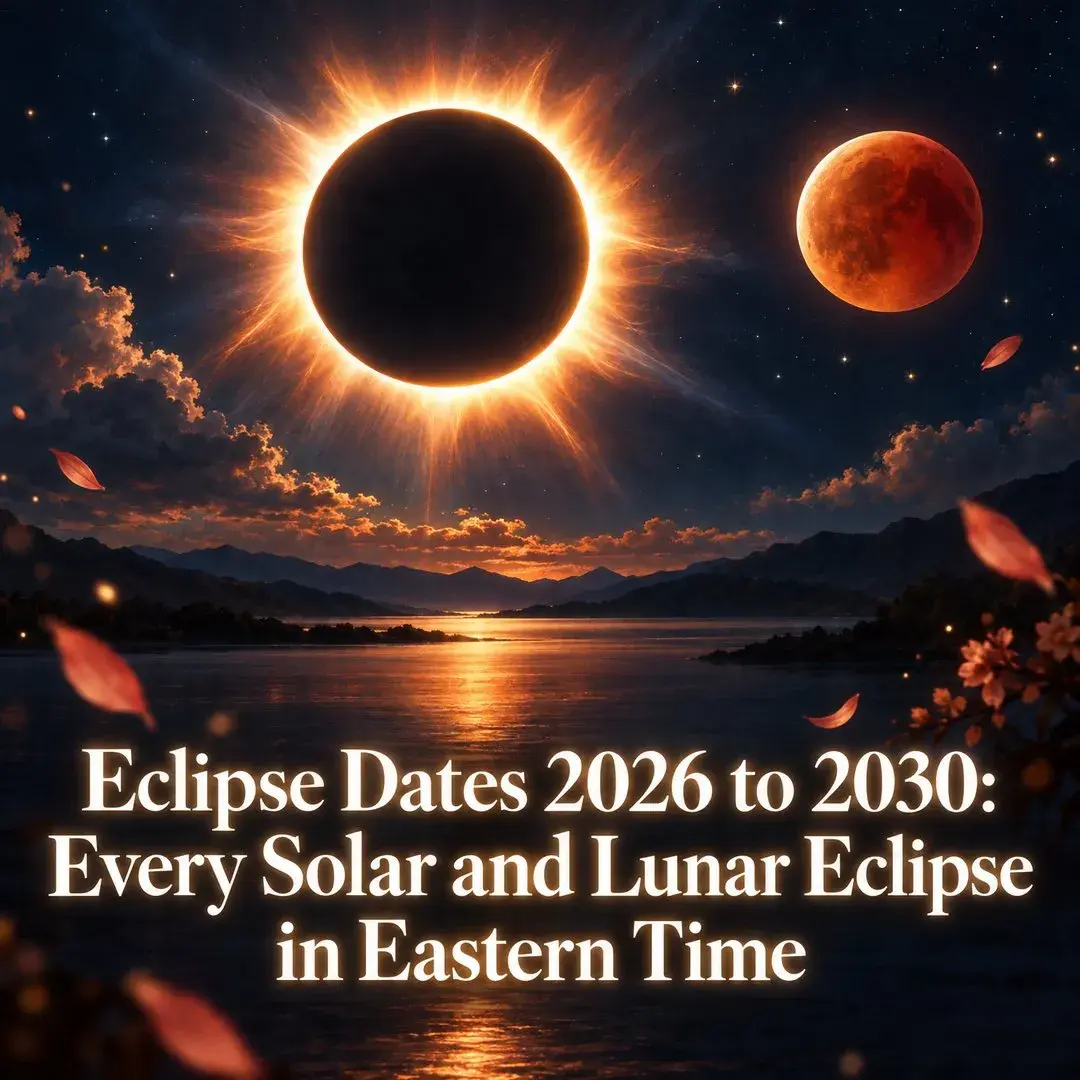
Eclipse Dates 2026 to 2030: Every Solar and Lunar Eclipse in Eastern Time
Quick answer: The next eclipse is an annular solar eclipse on February 6, 2027, at 10:59 AM Eastern time, in Aquarius. 2027 has five eclipses in all, including the long total solar eclipse of August 2, 2027. From 2026 through 2030 there are 24 eclipses: 12 solar and 12 lunar. Below you'll find every date, time, type and zodiac sign, plus what each kind of eclipse is said to mean.
Eclipses have always made people stop and look up. In astrology, they're seen as turning points, moments when something wraps up or something new begins. Whether you plan your year around them or you're simply curious, it helps to have every date in one place.
All times below are Eastern time (EST or EDT), taken from NASA's published eclipse tables. If you live in another time zone, the date can change, especially for eclipses near midnight.
Eclipses in 2026
| Date and time (ET) | Type | Sign | Seen from |
|---|---|---|---|
| February 17, 7:11 AM | Annular solar | Aquarius | Antarctica; partial in far southern South America and southern Africa |
| March 3, 6:33 AM | Total lunar | Virgo | East Asia, Australia, the Pacific, the Americas |
| August 12, 1:45 PM | Total solar | Leo | Total over Greenland, Iceland and Spain; partial in Europe, West Africa and far northern North America |
| August 28, 12:12 AM | Partial lunar | Pisces | The Americas, Europe, Africa, eastern Pacific |
Looking back on the August 2026 pair? Our pages on the August 2026 solar eclipse and the August 2026 partial lunar eclipse cover what they meant.
Eclipses in 2027
| Date and time (ET) | Type | Sign | Seen from |
|---|---|---|---|
| February 6, 10:59 AM | Annular solar | Aquarius | Ring of fire over Chile, Argentina and the Atlantic; partial in South America and western and southern Africa |
| February 20, 6:13 PM | Penumbral lunar | Virgo | The Americas, Europe, Africa, Asia |
| July 18, 12:03 PM | Penumbral lunar | Capricorn | East Africa, Asia, Australia, the Pacific |
| August 2, 6:06 AM | Total solar | Leo | Total across Spain, North Africa and the Arabian Peninsula; partial in Europe, Africa, the Middle East and Asia |
| August 17, 3:13 AM | Penumbral lunar | Aquarius | The Pacific and the Americas |
February 6, 2027: An Eclipse on Lunar New Year
The first eclipse of 2027 is an annular solar eclipse, the kind people call a "ring of fire," because the Moon covers the center of the Sun and leaves a bright ring around the edge. It happens at 17 degrees Aquarius and lands on the same day as the Lunar New Year, February 6, 2027. It also opens the busiest stretch of early 2027: Mercury turns retrograde three days later, on February 9. Our guide to Mercury retrograde in February 2027 walks through that season.
In astrology, a solar eclipse in Aquarius points toward fresh starts with friends, community, causes you care about and your own sense of independence. It's a natural time to ask, "What kind of future am I building, and who do I want beside me?"
February 20, 2027: A Quiet Eclipse on the Snow Moon
Two weeks later, a penumbral lunar eclipse falls on the Snow Moon in Virgo. Penumbral eclipses are subtle. The Moon dims slightly, and many people won't notice it at all. Astrologically, it's a soft nudge to let go of a habit, a worry or a to do list that no longer serves you. Our February 2027 lunar eclipse guide covers it sign by sign.
August 2, 2027: The Long Total Eclipse
This is the eclipse people are already talking about. Totality lasts more than six minutes near Luxor, Egypt, which makes it one of the longest total solar eclipses of this century. The path of totality crosses southern Spain, North Africa and the Arabian Peninsula. It isn't visible across the United States. In astrology it falls at 10 degrees Leo, a sign of confidence, creativity and being seen, so many astrologers frame it as a moment to step into your own light.
The penumbral eclipses of July 18 and August 17 round out the summer. See our August 2027 lunar eclipse guide for that one.
Eclipses in 2028
| Date and time (ET) | Type | Sign | Seen from |
|---|---|---|---|
| January 11, 11:13 PM | Partial lunar | Cancer | The Americas, Europe, Africa |
| January 26, 10:07 AM | Annular solar | Aquarius | Ring of fire over Ecuador, Peru, Brazil, Spain and Portugal; partial in eastern North America |
| July 6, 2:19 PM | Partial lunar | Capricorn | Europe, Africa, Asia, Australia |
| July 21, 10:55 PM | Total solar | Cancer | Total over Australia and New Zealand (July 22 local time there) |
| December 31, 11:52 AM | Total lunar | Cancer | Europe, Africa, Asia, Australia, the Pacific |
Two things stand out in 2028. The January 26 annular eclipse falls on Lunar New Year again, just as it did in 2027. And the year ends with a total lunar eclipse on New Year's Eve, at 11:52 AM Eastern time, which is daytime in North America, so it's best seen from the other side of the world.
Eclipses in 2029
| Date and time (ET) | Type | Sign | Seen from |
|---|---|---|---|
| January 14, 12:12 PM | Partial solar | Capricorn | North and Central America |
| June 12, 12:05 AM | Partial solar | Gemini | The Arctic, Scandinavia, Alaska, northern Canada, northern Asia |
| June 25, 11:22 PM | Total lunar | Capricorn | The Americas, Europe, Africa, the Middle East |
| July 11, 11:36 AM | Partial solar | Cancer | Southern Chile and Argentina |
| December 5, 10:02 AM | Partial solar | Sagittarius | Southern Argentina and Chile, Antarctica |
| December 20, 5:42 PM | Total lunar | Gemini | The Americas, Europe, Africa, Asia |
2029 is a six eclipse year, and it's a good one for North America. The January 14 partial solar eclipse can be seen across much of the continent, and both total lunar eclipses, on the night of June 25 and the evening of December 20, are visible from the Americas. Our guide to the spiritual meaning of a total lunar eclipse is a good companion for those nights.
Eclipses in 2030
| Date and time (ET) | Type | Sign | Seen from |
|---|---|---|---|
| June 1, 2:28 AM | Annular solar | Gemini | Ring of fire from North Africa across Greece, Turkey, Russia, northern China and Japan; partial in Europe, Asia and Alaska |
| June 15, 2:33 PM | Partial lunar | Sagittarius | Europe, Africa, Asia, Australia |
| November 25, 1:50 AM | Total solar | Sagittarius | Total over Botswana, South Africa and Australia |
| December 9, 5:27 PM | Penumbral lunar | Gemini | The Americas, Europe, Africa, Asia |
The Four Kinds of Eclipses, Simply Explained
Total solar eclipse. The Moon covers the Sun completely for a few minutes and the sky goes dark in the middle of the day. In astrology, it's the strongest symbol of a new chapter.
Annular solar eclipse. The Moon is a little farther from Earth, so it doesn't quite cover the Sun, and a bright ring stays visible. Astrologers often read it as a fresh start that asks you to keep some of what came before.
Partial eclipse. Only part of the Sun or Moon is covered. The theme is a smaller adjustment rather than a big turn.
Penumbral lunar eclipse. The Moon passes through Earth's outer shadow and dims just a little. It's the gentlest kind, more of a whisper than a headline.
For a deeper look at meaning, read our guides to the spiritual significance of a solar eclipse and what a solar eclipse means for your zodiac sign.
Wondering What an Eclipse Season Means for You?
The Psychic Line is an independent psychic service you can trust, since 1991. Call us at (800) 966 2294 to connect with a reader, or book an astrology reading or spiritual reading whenever you feel ready. New client readings start at $30 for a full 15 minutes.
What Is an Eclipse Season?
Eclipses come in pairs or small groups, about two weeks apart, roughly every six months. Astrologers call each group an eclipse season. A solar eclipse always comes with a new moon, and a lunar eclipse always comes with a full moon.
Many people say eclipse seasons feel unsettled or fast moving. Plans change, conversations open up, and things you've been avoiding seem to ask for attention. If you've ever wondered, "Why does everything feel so stirred up right now?", an eclipse season can be part of the answer. It's also worth remembering that ordinary life, stress and timing shape how you feel. The sky describes a season. You still choose what to do with it.
How to Work With an Eclipse
- Before a solar eclipse: Think about what you'd like to begin. Write a few intentions, but hold them loosely. Many astrologers suggest waiting a few days before starting something big.
- Before a lunar eclipse: Think about what you're ready to release. A habit, a grudge, an old story about yourself.
- In relationships: Eclipses often bring honest conversations. If something has been left unsaid, this can be a natural time to say it, kindly. Our article on how a solar eclipse can affect relationships explores this.
- For men who like a plan: Treat eclipse weeks as checkpoints. Review goals, notice what has changed, and adjust your strategy before you commit to the next big move.
If you'd like to set intentions with the energy of a solar eclipse, our guide on how to manifest during a solar eclipse has simple steps. And if you're planning ahead, our 2027 astrology calendar shows every eclipse alongside the retrogrades and full moons.
A note on safety: Never look straight at the Sun during a solar eclipse, even a partial one. Use certified eclipse glasses or a pinhole viewer, and follow NASA's eclipse safety guidance. Lunar eclipses are safe to watch with your eyes.
Keep Exploring
Frequently Asked Questions
When is the next eclipse?
The next eclipse is the annular solar eclipse on February 6, 2027, at 10:59 AM Eastern time, in Aquarius. It's best seen from southern South America, where the "ring of fire" crosses Chile and Argentina. It falls on the same day as Lunar New Year 2027. A penumbral lunar eclipse follows on February 20, 2027.
How many eclipses are there in 2027?
There are five eclipses in 2027: an annular solar eclipse on February 6, penumbral lunar eclipses on February 20, July 18 and August 17, and a total solar eclipse on August 2. The August 2 eclipse has more than six minutes of totality near Luxor, Egypt, one of the longest of this century.
Can you see the August 2, 2027 total solar eclipse from the US?
No, it isn't visible across the United States. The path of totality crosses southern Spain, North Africa and the Arabian Peninsula, and a partial eclipse is seen across Europe, Africa, the Middle East and parts of Asia. Many people are already planning trips to see it in person.
What is the difference between a solar and a lunar eclipse?
A solar eclipse happens when the Moon passes between the Sun and Earth, and it always falls on a new moon. A lunar eclipse happens when Earth's shadow falls on the Moon, and it always falls on a full moon. In astrology, solar eclipses are linked with beginnings and lunar eclipses with endings and release.
Should I worry about an eclipse?
No. Eclipses are natural events, and there's nothing to fear in them. In astrology they're seen as turning points that highlight change, reflection and new direction. Some people feel more emotional or restless around them, which is normal. You stay in charge of your choices, and an eclipse can simply be a helpful moment to pause and reset.
Why do eclipse dates change in different time zones?
An eclipse happens at one moment for the whole world, but the local clock time depends on where you are. The total solar eclipse of July 22, 2028 in Australia is still July 21 in Eastern time. This page lists every eclipse in Eastern time so dates stay consistent for readers across the US and Canada.
Ready to Talk with a Gifted Reader?
The Psychic Line is an independent psychic service you can trust, since 1991. Call us at (800) 966 2294 to connect with a reader, or book a relationship reading or clairvoyant reading whenever you feel ready. New client readings start at $30 for a full 15 minutes.
- Log in to post comments