
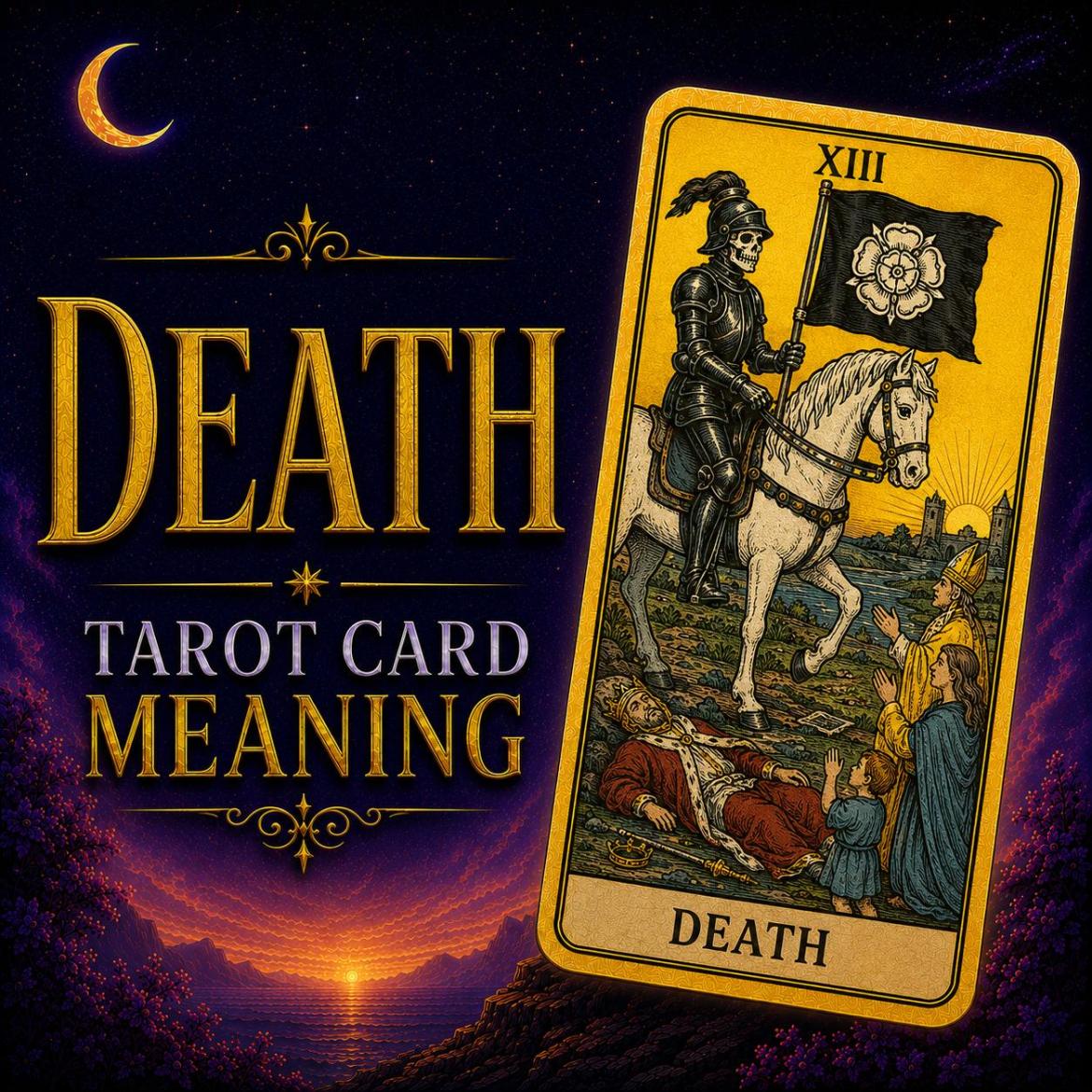
The Death card is number 13 in the Major Arcana, and it is almost certainly the most misunderstood card in the tarot deck. When people who do not know tarot see this card, the word "Death" and the skeletal rider on a horse create fear. But in the tarot, Death almost never means literal death. What it means is transformation: the kind of deep, complete, irreversible change that happens when something that has genuinely run its course comes fully to an end and makes way for something entirely new. Death follows The Hanged Man's voluntary surrender and takes that letting go to its ultimate conclusion. What was being held is now released completely. The cycle closes. Something genuinely new becomes possible.
What the Death Tarot Card Symbolizes
In the Rider-Waite-Smith deck, a skeleton in black armor rides a white horse across a landscape in which people of all social stations have fallen. A pope, a king, a woman, a child, all lie in the path of the horse or kneel before it. Death does not discriminate by rank, age, or status. The white horse carries an undeniable authority that no human distinction can deflect.
The skeletal figure carries a black banner emblazoned with a white rose, the same rose of purity and new life that appears in many other cards. Even in the imagery of Death, the symbol of life and renewal is present. This is not nihilism. It is the recognition that genuine renewal requires genuine ending, that the white rose can only bloom because the old growth has been cleared away completely.
In the background, the sun rises between two towers, the same towers that appear in The Moon. The sun rises over the landscape of death and transformation, suggesting that the light that comes after this kind of ending is not a smaller, weaker light but the full light of a new day: the sun that was always there, now fully risen and visible because the obstructions are gone.
Death Tarot Keywords
Upright: transformation, endings, transition, letting go, change, closure, release, new beginnings, irreversible change, clearing, the cycle completing
Reversed: resistance to necessary change, inability to let go, clinging to what has ended, fear of transformation, stagnation, refusing closure
Death Numerology, Astrology, and Element
The Death card carries the number 13, which in many cultures carries associations with the uncanny and the threshold of what is known. Thirteen is the number after the twelve completions (twelve months, twelve apostles, twelve signs of the zodiac) and represents the beginning of what is beyond the familiar cycle. It is the liminal number: the threshold between what was and what comes next.
Element: Water, the element of depth, of the unconscious, of the emotional and soul level processes that govern genuine transformation. Water dissolves what is solid, carries away what has ended, and creates the fluid space in which new life can take form. Real transformation, the kind the Death card represents, happens at the level of soul and emotion, not just the surface of circumstance.
Zodiac sign: Scorpio, the sign most directly associated with death, transformation, depth, power, and the capacity to go down into the deepest territory and emerge genuinely changed. Scorpio governs the full cycle of transformation: the willingness to fully release what has ended in order to fully receive what is waiting to begin. No sign understands the necessity of endings for renewal more deeply than Scorpio.
Death Upright Meaning
The Death card upright means a significant ending, transition, or transformation is active or imminent, and the most important thing you can do is release what has genuinely run its course rather than clinging to it past the point where holding on serves anything real.
When the Death card appears upright, something is ending. This may be a relationship, a job, a phase of life, a belief system, a self image, or a way of being in the world. The key word here is genuinely: what is ending has genuinely run its course. It is not being taken prematurely. The cycle has completed, and the completion is real.
The Death card does not predict grief or suffering. It predicts transformation. But transformation requires that the ending be genuinely accepted and fully released rather than fought, mourned excessively, or held on to past its time. The skeleton on the white horse moves forward with complete inevitability. The people in its path who are able to kneel and acknowledge the turning are honoring something real. The ones who try to stand in the way of it find only that its progress does not stop.
There is also a promise in this card that is easy to miss when the focus is on the ending itself: the white rose on the banner, the sunrise in the background. What comes after genuine ending is genuinely new. Not a patched up version of what ended. Something with the freshness and fullness of something that has never existed before.
Death Reversed Meaning
The Death card reversed means something that needs to end is not being allowed to end: it is being clung to, resisted, or fought in ways that are preventing the genuine transformation that the ending would make possible.
When the Death card appears reversed, the energy of the upright card is present but blocked. The cycle has completed or is completing, but the release is being refused. This refusal takes different forms: staying in a relationship, job, or situation that has clearly run its course out of fear of what comes after; refusing to let go of a self image or belief system that no longer serves; or simply being so afraid of the unknown that any amount of familiar discomfort feels more bearable than the blank space of genuine transition.
The cost of this refusal is that the new thing that the ending would have made space for cannot arrive. The Death card reversed keeps people in a kind of living stagnation: present in a situation that is no longer alive, unable to move into what is genuinely waiting. The transformation is not prevented by refusing it. It is only delayed, and made more difficult.
Death in Past, Present, and Future Positions
Death in the Past Position
The Death card in the past position points to a significant transformation or major ending in the past that fundamentally changed the direction of your life. What ended then, whatever it was, cleared space for what became possible afterward. That ending is part of the foundation you are standing on now, even if the transformation it required was genuinely painful at the time.
Reversed in the past position: A significant change that was resisted, an ending that was not fully accepted, and the patterns of clinging or avoidance that developed then may still be influencing how you respond to change and transition now.
Death in the Present Position
The Death card in the present position means a significant transformation is actively underway right now. Something is ending, or in the process of ending, and the most powerful thing you can do is to allow that ending to be complete rather than trying to hold on past the point where what you are holding still has real life in it.
Reversed in the present position: Something that needs to end is being resisted right now, and the resistance is costing more than the ending would. Identifying what it is and why it is being held onto is the most important work available in this moment.
Death in the Future Position
The Death card in the future position means a significant transformation is ahead: a major ending that clears the way for something genuinely new. This is not a warning of loss. It is a preparation for the kind of deep, irreversible change that makes genuine renewal possible. What ends will have genuinely run its course, and what becomes possible afterward will be fully real.
Reversed in the future position: Watch for the temptation to resist or deny a necessary ending when it comes. The smoother you can allow the transformation to be, the sooner the genuine new beginning becomes available.
Death Tarot Meaning in Love and Relationships
In a love reading, the Death card upright represents a major transformation in the relationship or in your love life: either a significant ending that is genuinely complete, or a transformation that changes the nature of the relationship so fundamentally that what comes after is something genuinely new.
For a relationship that has truly run its course, the Death card is clear: the ending is real, and clinging to what has ended will only prevent the genuine new beginning that is waiting on the other side. This is not a comfortable message, but it is an honest one, and the card always carries within it the promise of the white rose: what comes after a genuine ending has its own genuine life.
For a relationship that is not ending but transforming, the Death card can indicate a transition between phases that is so fundamental it almost feels like the end of the relationship as it has been known. The emergence into the new phase is a kind of rebirth.
Reversed in love: Refusing to end a relationship that has genuinely run its course, or fighting a transformation within a relationship that would actually make it more genuinely alive if it were allowed to happen.
Death Tarot Meaning in Career and Finances
In a career reading, the Death card points to a significant professional transformation: a major ending, transition, or fundamental change in direction that clears the way for something genuinely new to emerge.
This can indicate leaving a job, a career path, or a professional identity that has run its course. It can also indicate the end of a business, a professional partnership, or a phase of professional life that no longer reflects who you genuinely are. What feels like loss in these situations is also always a clearing: the space that opens when something that was no longer alive professionally is released is exactly the space that something genuinely new can fill.
Financially, the Death card can point to a significant financial change or the end of a financial phase, such as paying off a debt, closing a business, or ending a financial arrangement that has run its course. Clear, complete endings in financial matters create genuine space for new financial realities.
Reversed in career: Staying in a professional situation that has genuinely ended out of fear or inertia, or resisting a major professional transition that would actually open significant new possibilities.
Is Death a Yes or No Card?
The Death card is generally a yes for questions about endings and transformation, and it carries within its yes the understanding that what ends makes space for what genuinely follows.
If the question is about whether something has ended: yes, the ending is real. If the question is about whether a major change is coming: yes, and the change will be deeper and more fundamental than it might currently appear. The Death card's yes is not the yes of easy continuation. It is the yes of genuine transformation.
For questions about starting something new, the Death card can indicate that a yes to the new thing requires a complete yes to the ending of the old thing: the two are inseparable.
Frequently Asked Questions About the Death Tarot Card
Does the Death tarot card mean someone will die?
Almost never. In tarot readings, the Death card almost always represents transformation, significant endings, and the deep change that happens when something that has genuinely run its course is fully released. Tarot readers do not use this card to predict literal death, and when it appears in a reading, the honest message is about transformation and renewal, not about physical death.
What does the Death tarot card mean?
The Death tarot card means transformation, significant endings, and the genuine new beginning that only becomes possible when what has truly run its course is fully and completely released. It is the card of deep, irreversible change: the clearing that is necessary for something genuinely new to emerge. The white rose on the Death card's banner is always there, promising that renewal follows genuine ending.
What does Death reversed mean?
Death reversed means something that needs to end is not being allowed to end: it is being clung to, resisted, or fought past the point where holding on serves anything real. This keeps people in a kind of stagnation, present in situations that are no longer alive, unable to move toward what is genuinely waiting on the other side of the necessary ending.
Is Death a yes or no card?
The Death card is generally a yes for questions about transformation, endings that are genuinely complete, and the real change that comes when something has run its full course. Its yes acknowledges what is ending while pointing to what becomes possible as a direct result of that ending. Reversed, it can indicate the ending needs to be more fully accepted before the yes to what follows can be real.
What does Death mean in a love reading?
In a love reading, the Death card can represent a major transformation in a relationship or the genuine end of one. For relationships that have truly run their course, it affirms the ending is real and that release will open space for something genuinely new. For ongoing relationships, it can indicate a transformation so fundamental it feels like a rebirth into something different and more genuinely alive.
What number is the Death card?
Death is number 13 in the Major Arcana. Thirteen is the liminal number: the threshold between what was and what comes next, the number after the twelve great completions. It carries the energy of crossing from one reality into another, of standing at the edge of what is known and moving into genuinely new territory.
What zodiac sign is the Death card?
The Death card is associated with Scorpio, the sign most deeply connected to transformation, depth, power, and the full cycle of death and rebirth. Scorpio understands that genuine renewal requires genuine release: that you cannot receive what is new while still holding on to what is ended. No sign navigates the necessity of endings for true new beginnings more completely.
What does Death mean in the future position?
The Death card in the future position means a significant transformation is ahead: a major ending that clears space for something genuinely new. This is preparation for deep, irreversible change, not a warning of loss. What ends will have genuinely run its course, and what becomes possible afterward will carry the freshness and fullness of something that has never existed before.
When to Call a Psychic About the Death Card
The Death card appears when someone is in the middle of a major transformation and needs help understanding what is genuinely ending, what is being offered on the other side, and how to move through the transition with as much clarity and genuine openness as possible. These are among the most significant moments in a life, and a reading can help you understand not just what is being lost but what is genuinely becoming possible. Call us at (800) 966 2294.
Related Tarot Cards
The Death card follows The Hanged Man in the sequence, completing the transformation that The Hanged Man's willing surrender began. Temperance follows Death and represents the integration and restoration that becomes possible after the transformation is complete: the patient, graceful work of bringing the new reality into a balanced and sustainable form. The Tower later in the deck represents the sudden, involuntary version of the transformation Death describes: both involve fundamental change, but where the Death card represents a cycle completing naturally, The Tower represents the sudden clearing of what was not honestly seen or genuinely addressed. If Death appeared alongside Judgement in your reading, the combined message speaks to a transformation that is also a reckoning: a genuinely complete ending and the honest understanding of what it means for who you are and what you are building going forward.